
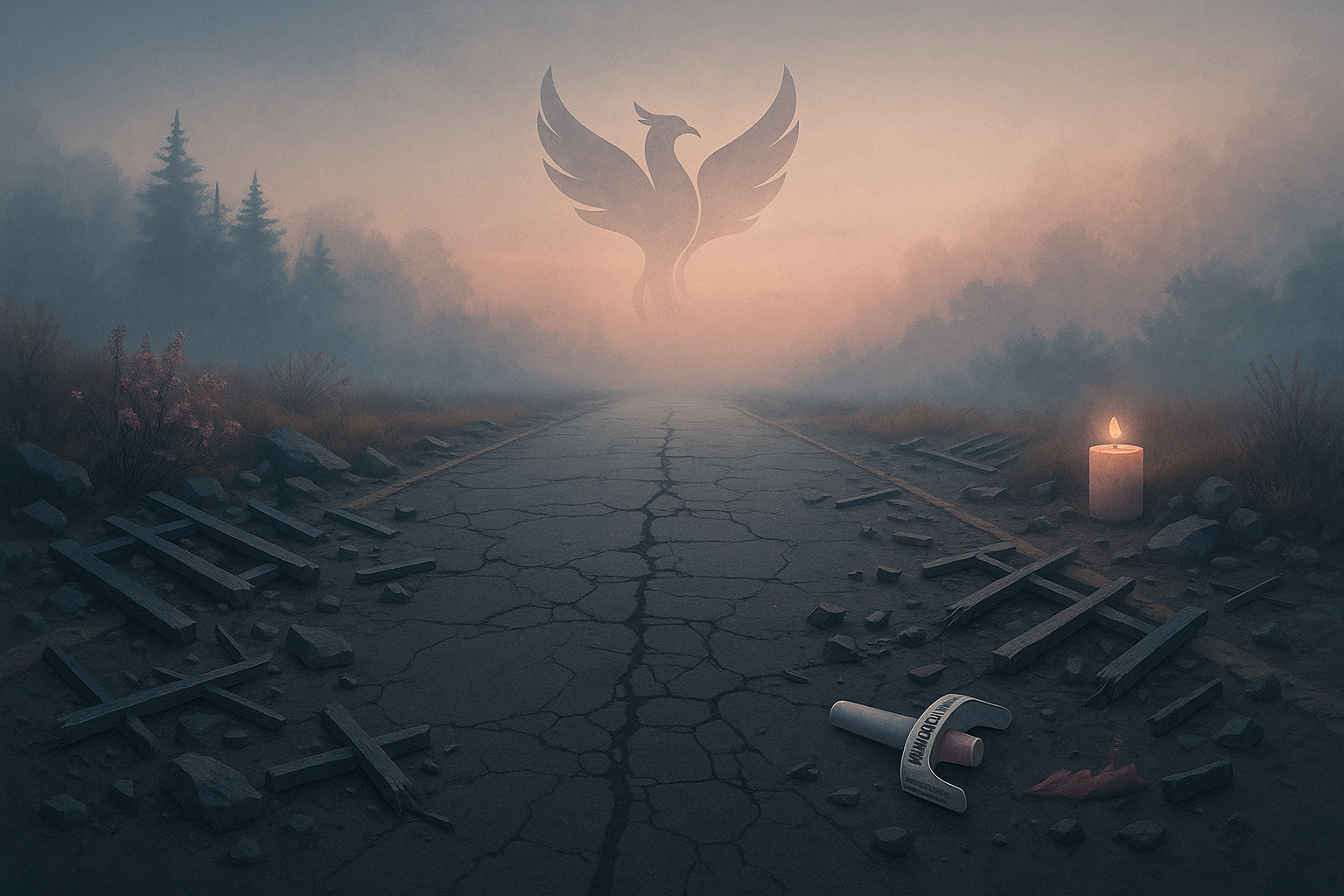
Sunday morning. The church on the corner is full. Families are dressed in their best. Children hold hands with their parents, heads bowed in prayer. Across the street, the homeless shelter is just as busy—but the faces are different. There are no suits or Sunday dresses, just worn-out shoes, tattered blankets, and tired eyes that have seen too much. And in the alley behind them both, the trap house is wide open. It’s early, but people are already lined up. They’ve scraped together enough change—maybe begged for it, maybe stole it—just to get a little more of whatever numbs the pain.
It’s the same alley where, just the night before, a few stronger guys had cornered someone who shouldn’t even be out there—a younger man, clearly struggling. They muscled him up against a wall and robbed him of whatever he’d made that day. Maybe it was change from collecting cans. Maybe it was a few bucks someone gave him out of kindness. Either way, it was gone. Taken by people just as desperate, just as lost, clawing for the next high.
Thanks for reading! Subscribe for free to receive new posts and support my work.
This is life in a town where the border cuts through more than land. It cuts through families, through morality, through the very idea of what it means to survive. From one corner, you can see it all—faith, desperation, addiction—ripping everything in between to shreds. The contrast is sickening. One building offers hope, the other offers dope. And somehow, both are full. One hands out prayers, the other, poison.
And in between, there are people who walk right past it all. Some of them in their Sunday best, Bibles in hand, eyes forward. They nod to the greeters at the door but don’t look at the man curled up across the street, or the girl shaking in the alley. They call themselves people of faith—but not everyone wants to see what’s next door. Not everyone can face it. And while it’s not fair to paint them all the same, the truth is this: a lot of people pray hard inside the church and look away just as hard when they step outside.
That’s the quiet war playing out here. The rich get richer off the sick, and nobody really talks about it. And while so many suffer and fade, some at the top of the chain thrive. You see them rolling through in luxury cars, wearing designer clothes, living in homes that look out of place in a neighborhood built on struggle. They didn’t build that life on dreams. They built it on overdoses, broken homes, and other people’s suffering. And as long as there’s pain, there’s demand. As long as there’s demand, the trap stays open.
But not every dealer is rich. Many of them are addicts themselves, caught in the same downward spiral. They’re not building empires—they’re barely keeping themselves above water. Selling becomes a means to survive without begging or constantly stealing. The decisions they make are often clouded by the very substances they’re using. Logic gets replaced by desperation.
In a life where they’re judged, avoided, and discarded everywhere else, the streets become the one place they still hold value. Out here, they’re not invisible. They have a purpose—even if that purpose is twisted. It might be the only place they feel seen. In their old lives—back when they had jobs, families, friends—they were met with concern, rejection, silence. But here, even in the dirt, they have a role. They have people who acknowledge them. And sometimes, that’s all someone needs to keep going—even if it’s killing them.
If you have even a little heart left, it eats at you. But if you stay here long enough, that empathy begins to rot into judgment. You start to think, “They put themselves here. They had a choice.” But did they? Most of the people sleeping on sidewalks didn’t just wake up one day and decide to throw it all away. Many of them were kids once. Hurt kids. Abused kids. Neglected kids. Kids who learned to carry trauma before they ever learned how to speak it. Somewhere along the way, they discovered something that made the pain stop—if only for a little while. Drugs became the comfort, the escape, the silence to the screaming inside their heads.
But the price is steep. Once addiction sets in, it doesn’t let go easy. Feeding it becomes the only thing that matters. You sell what you have. Then you steal. Then you rob. And sometimes, you die. Families try to help. They beg, they cry, they offer rehab, a place to stay, another chance, more prayers. But addiction doesn’t respond to love. It responds to chemicals. To cravings. To desperation.
And here’s the part that hurts to say, but has to be said: even with all the trauma, all the pain, all the injustice—change still has to be chosen. No one can do it for them. As brutal as the cycle is, there’s a moment—sometimes a hundred little moments—where the choice is there: to stop, to face it, to try. But facing reality is terrifying. Facing the trauma behind the addiction means ripping yourself open, reliving what you tried so hard to forget, and rebuilding something from rubble. That’s not easy. That’s hell. And a lot of people don’t feel strong enough to go through it.
So instead, they retreat. They numb. They point fingers. They blame everyone else. The system. Their parents. Their ex. Their childhood. And yeah—sometimes, they’re not wrong. But healing can’t start while you’re still giving your power away. Self-victimization becomes a shield. Blame becomes a distraction. And the truth gets buried under excuses. Because if they admitted they could choose something different, they’d have to admit they’re choosing this.
It’s not about judgment. It’s about truth. You can be hurt and still be responsible for your healing. You can be broken and still be the one who has to rebuild. No one can walk that road for you. And that’s the hardest part. Because recovery isn’t just about getting clean—it’s about waking up. And staying awake when everything in you wants to go numb again.
If you hang around long enough, you start to recognize the same faces. You watch them decay. Smiles turn into scabs. Voices turn to mumbling. Skin turns to ash. The eyes that once sparkled are now barely open, barely alive. You watch people you used to nod to on the street become unrecognizable—not because they changed, but because addiction took everything they had and still wants more.
We live in a country where addiction is still treated like a crime, not a crisis. Where the drug dealers are glamorized, and the addicted are demonized. Where the church prays, the shelter feeds, and the trap never sleeps.
And if that doesn’t break your heart, I don’t know what will.
Because the truth is, we’ve built a system that punishes symptoms and ignores causes. We cage people for using the very thing that helped them survive the worst parts of their lives. We flood prisons with the broken instead of building places to heal. And all the while, we act surprised when the cycle repeats—when the same faces come back, more hollow than before.
We throw the word “choice” around like it means the same thing to everyone. But choice doesn’t exist in a vacuum. It doesn’t mean much when you’re 13 and trying to numb the flashbacks. When you’re 25 and sleeping behind a dumpster with no ID and no one to call. When every door you’ve knocked on either slammed shut or never opened to begin with.
We praise recovery stories only after they’ve been cleaned up, sanitized, made palatable. But the truth is messy. It’s people relapsing twelve times before they make it once. It’s mothers who never made it back home. It’s fathers who still sleep under bridges. It’s kids visiting their parents through plexiglass windows.
And it’s not just happening in “bad neighborhoods” or in faraway cities. It’s happening everywhere. Behind gas stations, in small towns, in upscale suburbs. It’s not just a border town story—it’s America. The overdose crisis isn’t a fringe issue. It’s woven into the fabric now.
You can look away. You can judge. Or you can really see it.
See the humanity in the addict. The pain behind the dealer. The failure in the system.
And maybe—if enough of us care—see the beginning of something better.